
The Great Offloading
About gradual disempowerment and LLM usage.

If computers are bicycles for the mind, then generative AI is an souped-up, electric scooter. With the help of AI, you can go really fast. So fast it has led to companies creating leaderboards measuring which employees are spending the most amount of tokens, because token spending is seen by senior executives as a proxy for speed (i.e. productivity).
Incentivized by these leaderboards and the insane amount of pressure within companies to prove your worth as an AI-first employee that doesn’t want to get laid off, this has led to emergence of ‘tokenmaxxing’: the practice of artificially inflating your token usage — by running long agentic loops or generating ginormous amounts of unused code — to meet corporate productivity targets or gamify internal token scoreboards.
As a result, companies like Uber are burning through entire annual AI budgets in a matter of months, which would be funny if weren’t for the fact that at some point someone has to foot the bill and overspending is likely to come at the cost of, you’ve guessed it, laying off workers.
But there’s another hidden cost looming underneath all of this. A growing body of research points to the fact that people assisted by AI erode their ability to solve problems unaided. A recent study found that people who received help from AI would give up on challenging problems more quickly in the future. A second study found that passive use of AI is likely to reduce self-efficacy, ownership, and meaning at work, even though using it feels good initially.
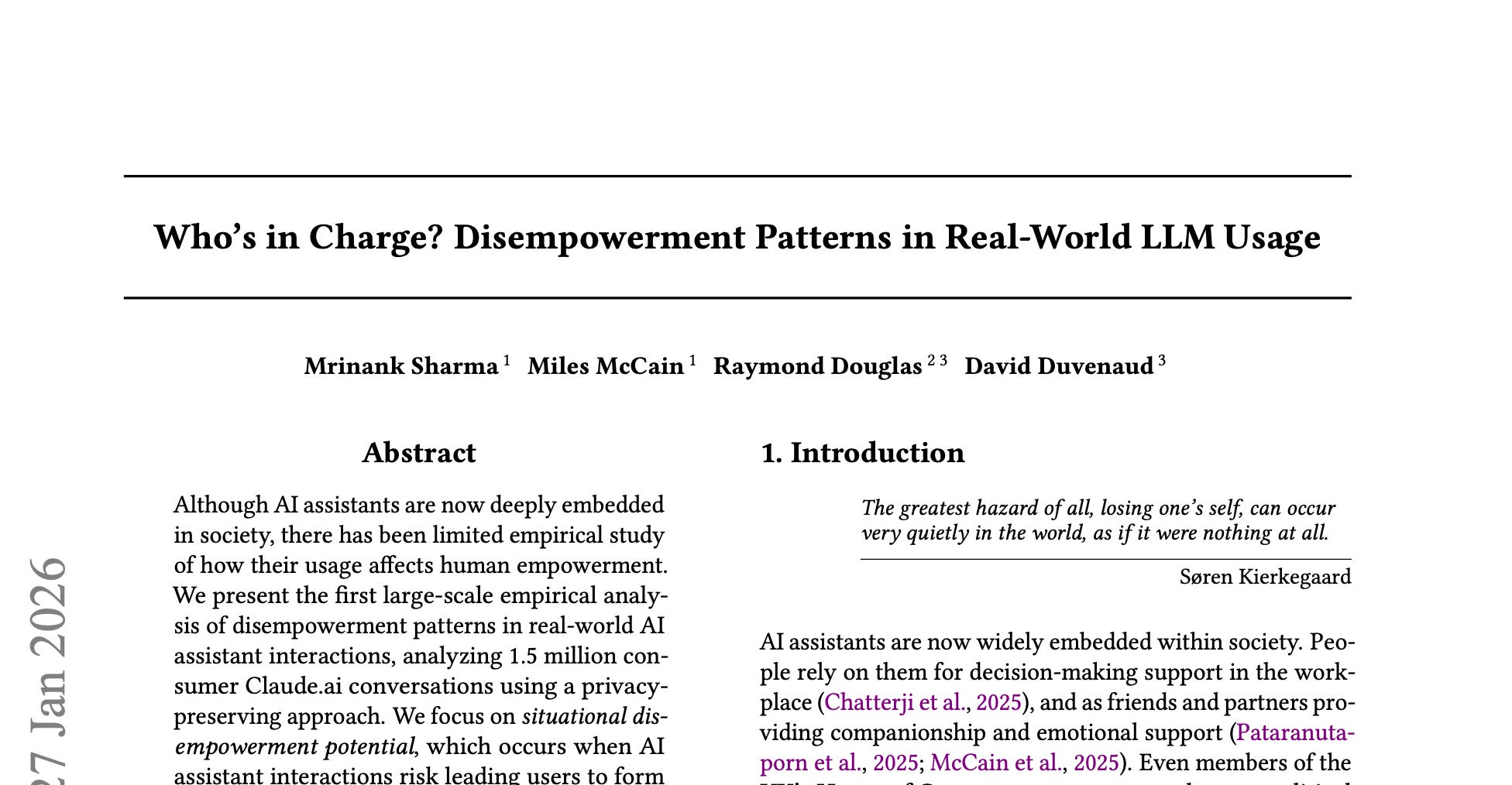
This shouldn’t come as a surprise. LLMs, especially the sycophantically-tuned ones, are superb at giving people the feeling of knowing without performing the labor of judgment. It makes people feel smart, so they use it more, sleepwalking into dependency. This is corroborated by a third study, based on the analysis of 1.5 million consumer Claude.ai conversations, the first large-scale empirical analysis of its kind:
We uncover concerning qualitative patterns (…) AI assistants act as moral arbiters, providing definitive character assessments—labeling individuals as “toxic,” “narcissistic,” or “abusive”—and prescribing relationship decisions without redirecting users to clarify their own values. We also find patterns of complete scripting, where the AI provides ready-to-use messages and step-by-step action plans for value-laden personal decisions that users appear to implement verbatim. We additionally find evidence of actualized disempowerment: users who adopted AI-validated conspiracy theories and took real-world actions based on those beliefs, and users who sent AI-drafted messages and subsequently expressed regret, recognizing the communications as inauthentic with phrases like “it wasn’t me” and “I should have listened to my own intuition”.
Given that enterprises are incentivizing employees to make maximum use of AI, one has to wonder: are employees gradually losing the very knowledge and expertise that once qualified them for the job, becoming dependent on AI assistance they can no longer work without?
Canary in the coal mine may be one of the very AI labs responsible for bringing this technology into the world: Anthropic. In a recent blog When AI builds itself, the company touts the fact Claude now writes 80% of all code internally.
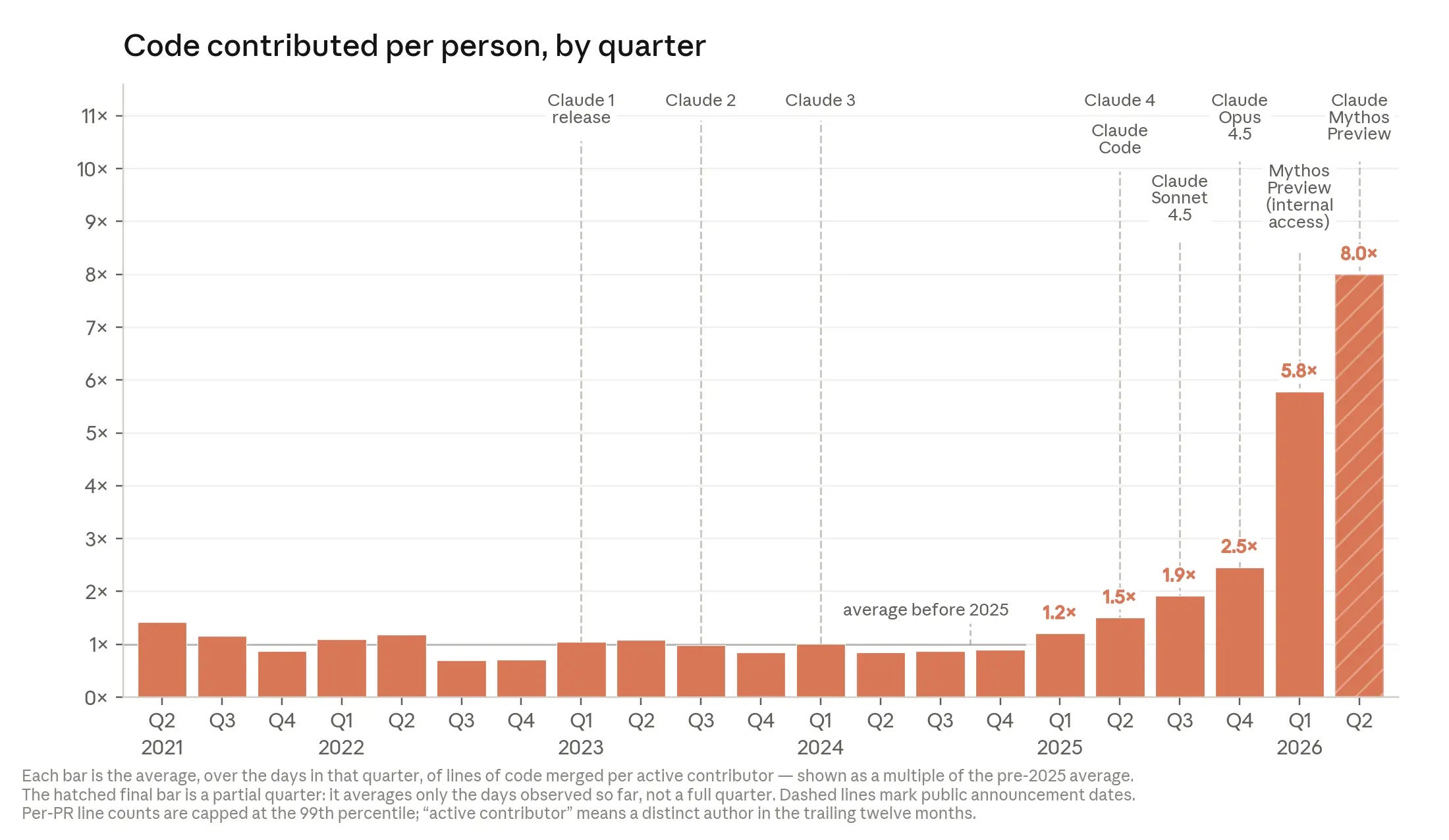
Before Claude Code launched in research preview in February 2025, that number was in the low single digits.
However, a quote from one of Anthropic’s software engineers isn’t exactly the flex they think it is:
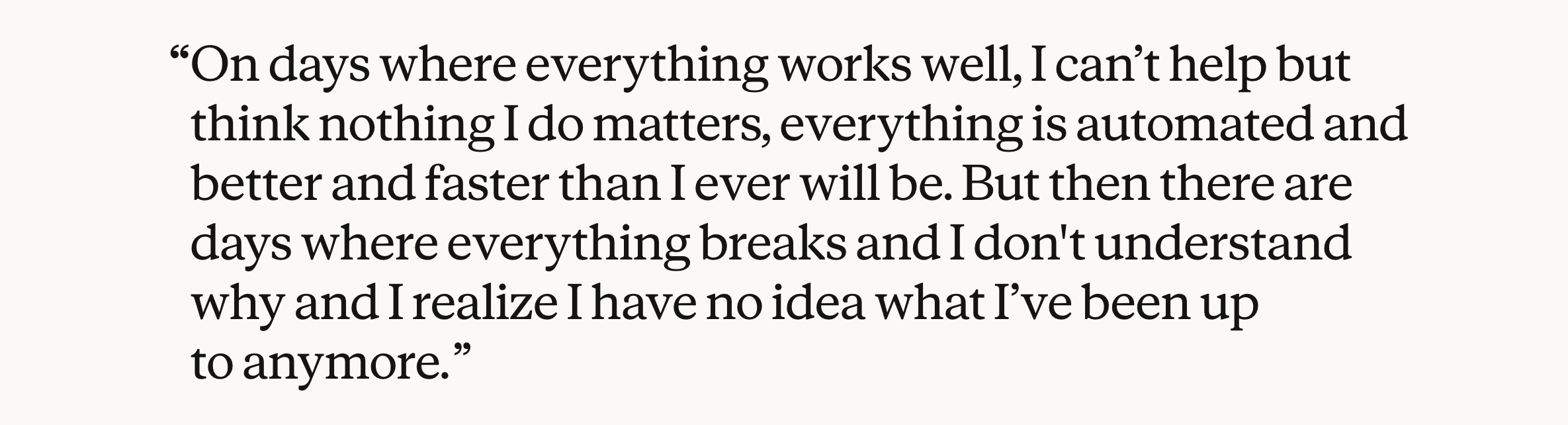
To me, this sounds more like the early signs of a phenomenon that I like to call: The Great Offloading.
What is likely to happen is that over the next decade, millions of white collars workers across finance, law, and accounting will effectively start to de-skill. As the machines take over more of the doing, skills that took people years to cultivate will slowly deteriorate. The loss will be so gradual that it will be barely noticeable. Most people’s work will involve reviewing the outputs the AIs produce, which people remain reasonably good at because they’ve previously been doing the work needed to build good judgment.
The next generation will have it worse. Think about it: senior software engineers didn’t became senior by reviewing code, but by writing it. One doesn’t become a great writer by just reading books. So once we take away the work, the muscle atrophies or worse, never develops in the first place.
But AI doesn’t just make it possible to offload work. It makes it possible to read, write, and have it structure your thoughts or judge the validity of a source for you. These are the basic components of critical thinking, which is arguably the root of all science, democratic civility, and human progress. It would be uniquely stupid of us to give up on that which has made us flourish.
Hopefully the pendulum swings the other way. While AI CEOs are telling us we are now standing in “foothills of the singularity”, convinced that AGI is but a few years away, we must remind ourselves that nothing is for certain. As we speak, exorbitantly high API bills are making enterprises reconsider their spending. Per-token prices may have fallen, but the advent of agents and reasoning have artificially inflated token usage with many more orders of magnitude, even though we were all promised “intelligence to cheap to meter”. That, and the fact that for both OpenAI and Anthropic can no longer sustain the subsidization of tokens (and with an IPO in sight are forced to switch to pay-by-usage-pricing), has got executives scratching their heads. When a single software engineer is spending more on tokens per month than it would cost to hire an entire team of software engineers, perhaps it is time to re-evaluate your AI strategy.
In the meantime, as individuals, we should stand for our dignity and preserve our autonomy. Here’s my prediction: the most valuable skill of the next decade won’t be prompt engineering. It will be the increasingly rare and curious ability to sit with one’s own thoughts.
Stay sane out there,
— Jurgen
This is spot on and terrifying. It's the curse of the algorithm supercharged.
As with most things, we worry about the polar extremes while the slow motion disaster occurs before our eyes.
Every tool extends a human capacity. The question is what happens when it also replaces the exercise of that capacity.