


There’s a growing negative sentiment towards AI. In the newsletter Blood in the Machine, journalist and writer Brian Merchant masterfully dissects what has been fueling people’s rage, which recently, regretfully, turned violent:
Inequality is through the roof. A bona fide tech oligarchy is ascendent, buffeted by leverage provided by AI. Its data centers, which bring few jobs and hike electricity bills, are enraging communities on the right and the left. Slop is everywhere. AI-generated art and text is undercutting creatives, powered by pirated, non-consensually ingested work. Employers from Amazon to Block to Duolingo to Meta are firing tens of thousands of workers and citing AI as the reason. AI may one day cure cancer, we’re told; great, even if we believe that, who will be able to afford the treatment?
That’s the anger fueling the anti-AI violence.
If you find yourself asking: what violence is he talking about? Here’s a quick rundown of three recent events that happened all in the span of a week: on Monday, April 6th, an unknown person fired 13 shots into the front door of Ron Gibson, a city councilman who had just voted to approve a new data center in Indianapolis. The shooter left a note saying ‘No Data Centers’ on his doorstep. On April 10th, a 20 year-old was arrested for throwing a molotov cocktail at OpenAI CEO Sam Altman’s house. And no less than two days later, the police arrested a 25 year-old and a 23 year-old for firing a gun, also aimed at the Altman’s house.
The reception online was a lot less oh-poor-Sam-Altman-and-poor-councilman and a lot more I-do-not-condone-violence-but-I-totally-get-where-this-is-coming-from, which is reminiscent of the killing of healthcare CEO Brian Thompson by the now infamous Luigi Mangione.
Were you the CEO of a big AI company, you could get the impression AI is suffering from a PR problem, and a reasonable solution to that problem, if you’re, say, OpenAI, could be acquiring TBPN; a daily talk show on AI with the goal to help “people understand the full impact of this technology on their daily lives”. Or, if you’re Google, you could publish a feature-length documentary telling the story of the boy-genius Demis Hassabis, CEO of DeepMind, but which makes no mention of co-founder Mustafa Suleyman who was placed on administrative leave after allegations of bullying or the fact that in 2015 DeepMind unlawfully obtained access to the personal records of 1.6 million hospital patients.
The reality is people don’t need help with understanding how AI is impacting their lives, because it already is. And they know damn well how to feel about it.
In a recent poll, Americans adults from across the political spectrum were asked if they think AI will do more harm than good. Categorized by income, the only group whose majority believes AI will be a net positive for society are people who make more than $200K dollars per year. Under $50K dollar per year, only 25% of people believe AI will do more good than harm.
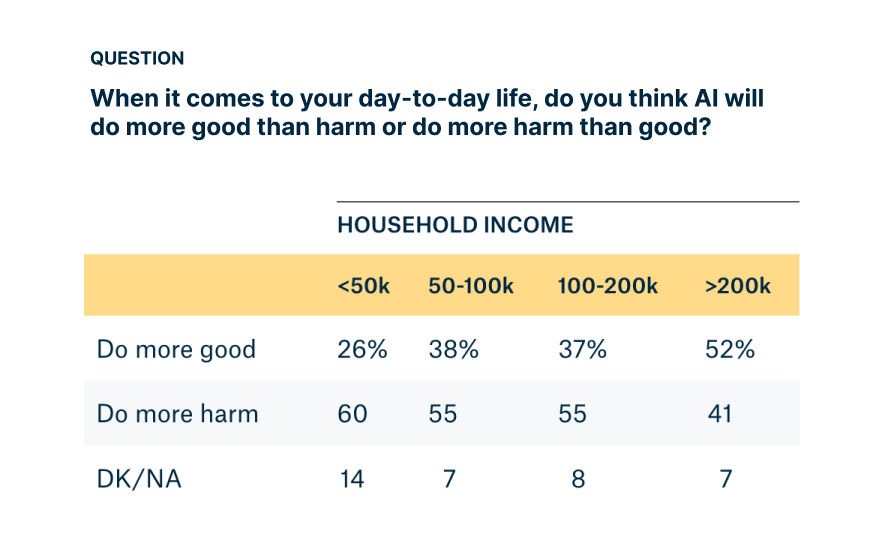
It seems like how people feel about AI is directly correlated with how much people earn, which doesn’t come as a surprise to me.
For normal people, life has become much more expensive — and AI isn’t helping with that. In states with a high concentration of data centers like Virginia, electricity prices have increased by up to 267% over the last five years. Such spikes are due to utilities needing to quickly deploy infrastructure, such as power lines and transformers, and pay extra for market-rate energy. Looking further ahead, prices are expected to increase by up to 40% by 2030 compared to 2025.
Does the AI industry care about this? Not in the slightest. In my home country, The Netherlands, data center company Goodman announced it is taking Dutch grid operator Tennet to court, demanding to be connected or receive a daily compensation of €500,000 euro. Tennet committed to connecting several new data centers near Schiphol but reversed course in January, citing grid overload. Since Tennet is state-owned and largely funded through grid fees that all Dutch electricity consumers pay, this court case could turn out to costly not just for Tennet but for every citizen in The Netherlands.
So, what are those data centers for? Well, AI CEOs are eager to paint vistas of the future, featuring things like “curing cancer” and “solving all of physics,” but in the same breath claim that if their project succeeds, AI will “wipe out 50% of entry-level white-collar jobs in 1-5 years.” And that’s if their project succeeds.
What happens if they fail? Funny you should ask. As it turns out, tech companies like Microsoft, Google, and Meta have been funding their massive AI buildout by raising hundreds of billions through private credit markets, often via special purpose vehicles (SPVs), in order to keep this debt of their balance sheets. Private lenders like Blackstone, Apollo, and Blue Owl have been eager to provide this financing, creating a deep entanglement between the private credit market and the AI infrastructure boom.
If AI doesn’t generate the revenues to justify all this spending, those loans default, and the echoes of 2008 will be hard to ignore. Just like the 2008 stock crash resulted in a foreclosure and unemployment crisis for millions who never touched a mortgage derivative, if AI fails to live up to its expectations it could mean job losses and shrinking retirement accounts for people who never made a single bet on AI.
It doesn’t take a genius to see that if the AI project succeeds, normal people are fucked. And if the AI project fails, normal people are also fucked.
The next conclusion we can make from that is that the AI industry isn’t suffering from a PR problem or a bad rep; their expanding efforts to build evermore capable AI systems, powered by bigger and bigger data centers, just isn’t making the lives of normal people better. The AI industry is out of touch.
You can see the disparity in perceptions of the general public vs. experts, too. Insiders — or, people living above the API, as they like to say in Silicon Valley — have a much more positive outlook on the long-term societal impact of AI than the general public — or, people living under the API. To be clear: people who live above the API are the ones who are safe from automation, the rest are, well, destined to be replaced.
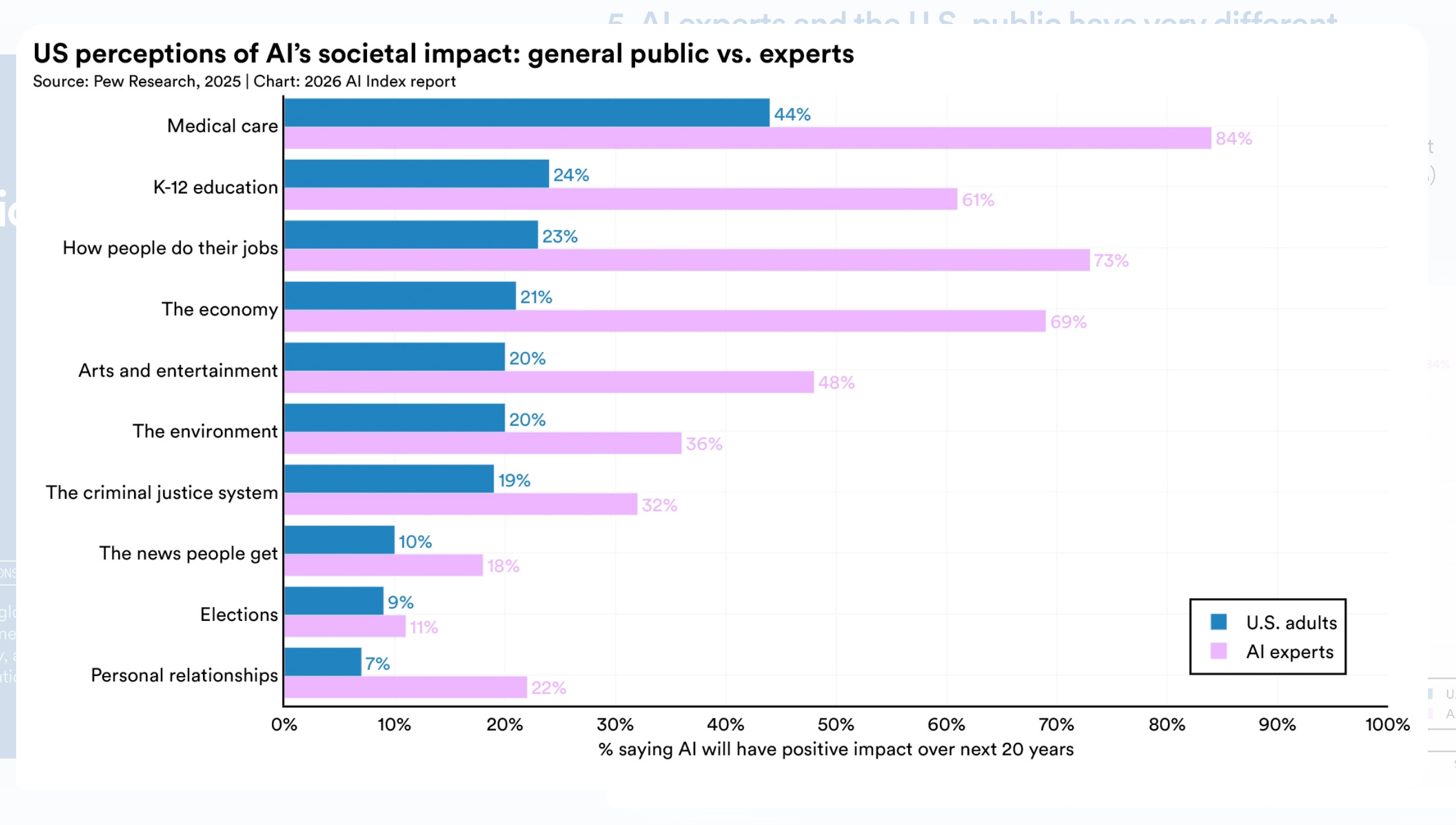
What it boils down to is that the people who feel most positively about AI are the ones who stand to benefit the most, whereas the rest of us are just supposed to sit back and await whatever is coming our way; whether it is the birth of superintelligence or the formation of another colossal financial bubble.
While I do not believe a violent uprising to be the answer, when you add it all up — an affordability crisis, a slowing job market, a depreciation of human skills and expertise, and a growing sense of uncertainty and powerlessness regarding the future and the future of our children — it sure makes for an explosive cocktail that could mark the beginnings of a revolution.
Be kind to each other,
— Jurgen
PS. A related episode of the Decoder podcast by Nilay Patel from The Verge, I can recommend to watch:
You've got the core problem right. The industry wants this to be a messaging failure because that's the kind of problem it knows how to fix.
Americans aren't confused, though. They've had forty years of technological "progress" that mostly meant consolidation at the top and precarity underneath. So when AI companies say this wave will transform the economy, people hear the old tune. They've heard it before about offshoring, about gig work, about every other round of disruption that left them holding less.
The interesting part is where that pattern breaks. In places where technology still feels like a ladder, AI optimism tracks with lived experience. India, China, parts of Africa, the Middle East. People there aren't naive. Their recent material history is just different.
And that's why the PR explanation feels thin. You can't communicate your way out of a material problem. The material problem just isn't the same everywhere. In America, a whole lot of people have learned to read "disruption" as a polite word for getting squeezed.
At this point, the AI industry has a legitimacy problem. Its leaders keep pressuring the public to accept a project that might erase jobs, strain power and water systems, concentrate more wealth, and destabilize whole communities, all in exchange for a vague promise that something extraordinary might arrive later. It is a reckless gamble with other people’s lives. Data centers are becoming the physical symbol of that bargain, they consume vital resources, offer little local benefit in return, and stand as monuments to a future most people never agreed to and cannot opt out of.